Activities and Sport
05 November 2026
Spotlight on Design Technology at the International School of Lausanne: From an Outstanding Educator Award to our First “Potato Olympics”
Read more

About us
Student Life
Community
Future Pathways
Contact
ISL Holiday Camps
The ISL Holiday Camps are dedicated to delivering safe, fun, and stimulating holiday experiences in the outdoors.
About us
Student Life
Community
Parent Teacher Association (PTA)
Alumni & Friends Community
Parent Hub Programme
Family Life in Lausanne
Contact
ISL Holiday Camps
The ISL Holiday Camps are dedicated to delivering safe, fun, and stimulating holiday experiences in the outdoors.
Future Pathways
Learn
Study at ISL
Academic Results
Bilingual Programme
Early Childhood
Primary Years Programme (PYP)
Middle Years Programme (MYP)
Diploma Programme (DP)
Diploma Programme Options
High School Diploma
Our Curriculum
Service Learning
The International Baccalaureate (IB)
Student Support Services
Future Pathways
5 November 2026 Kate MacLeod
When we learned that our Head of Design Technology, Mr Turland, was nominated this week for an Outstanding Educator Award by International School of Lausanne Class of 2026 alumnus, Francesco, as part of Chicago University’s unique, three-decade-old tradition designed to honour High School teachers who have left a lasting impact on newly admitted students, we were inspired to shine a light on some of the brilliant teaching and learning happening throughout Design Technology in both ISL Primary and Secondary.
First, a heartfelt thanks to the following for their support with this story: Francesco (Class of 2026), Saisha (Class of 2024), Divya (Class of 2024), Mr Marshall, Ms Schmid, Mr Carville, Mr Tkalec, and to all the ISL students pictured.
This blog started off as a socials post, but it quickly became obvious that there was no way one could even begin to do justice to the subject with Instagram’s limited word count; and so, a blog it had to be.
To begin: the story behind Mr Turland’s award…
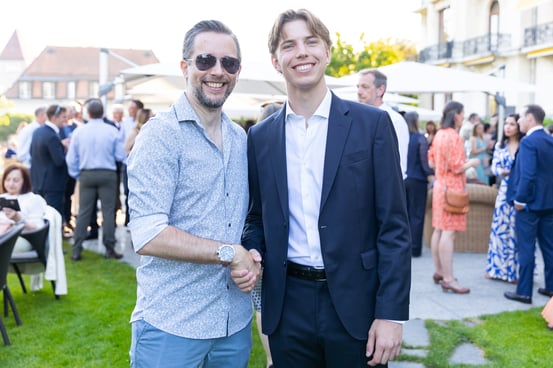 “I nominated Mr. Turland because he is the kind of educator who conveys a genuine passion for his subject while always giving students the space and encouragement to fail, learn, and try again,” revealed Francesco, who was taught by Mr Turland from Year 10 IB MYP Digital Design through to Higher Level Computer Science in the IB Diploma Programme, going on to achieve an impressive total IB score of 44/45.
Mr Turland and Francesco at ISL's Class of 2026 Graduation Celebrations (Credit: Kate MacLeod)
Passion for one’s subject is essential in enabling teachers to, at least, engage their students; and, at best, to stir a corresponding enthusiasm – however, speak to nearly every young learner, and they will undoubtedly share that the most important thing a teacher can do is create a classroom environment in which they not only feel safe to make mistakes, but feel secure in the knowledge that doing so is a fundamental stepping stone on the path to learning.
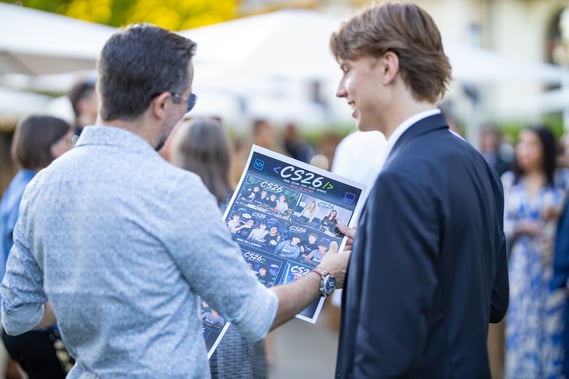
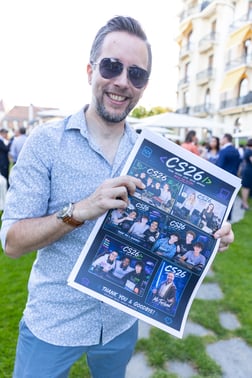
Mr Turland thoughtfully surprised his Class of 2026 Graduating Class with a poster starring them all (and their Jedi Master teacher, of course!) (Credit: K. MacLeod)
In fact, in the International School of Lausanne’s Primary Innovation Laboratory, colloquially referred to as the STEAM (Science, Technology, Engineering, Arts, and Mathematics) Lab, this philosophy is explicit: in vibrant colours, a cheery statement on the wall, structured empathetically from the perspective of the students themselves, declares: “Mistakes are proof I’m trying!!”
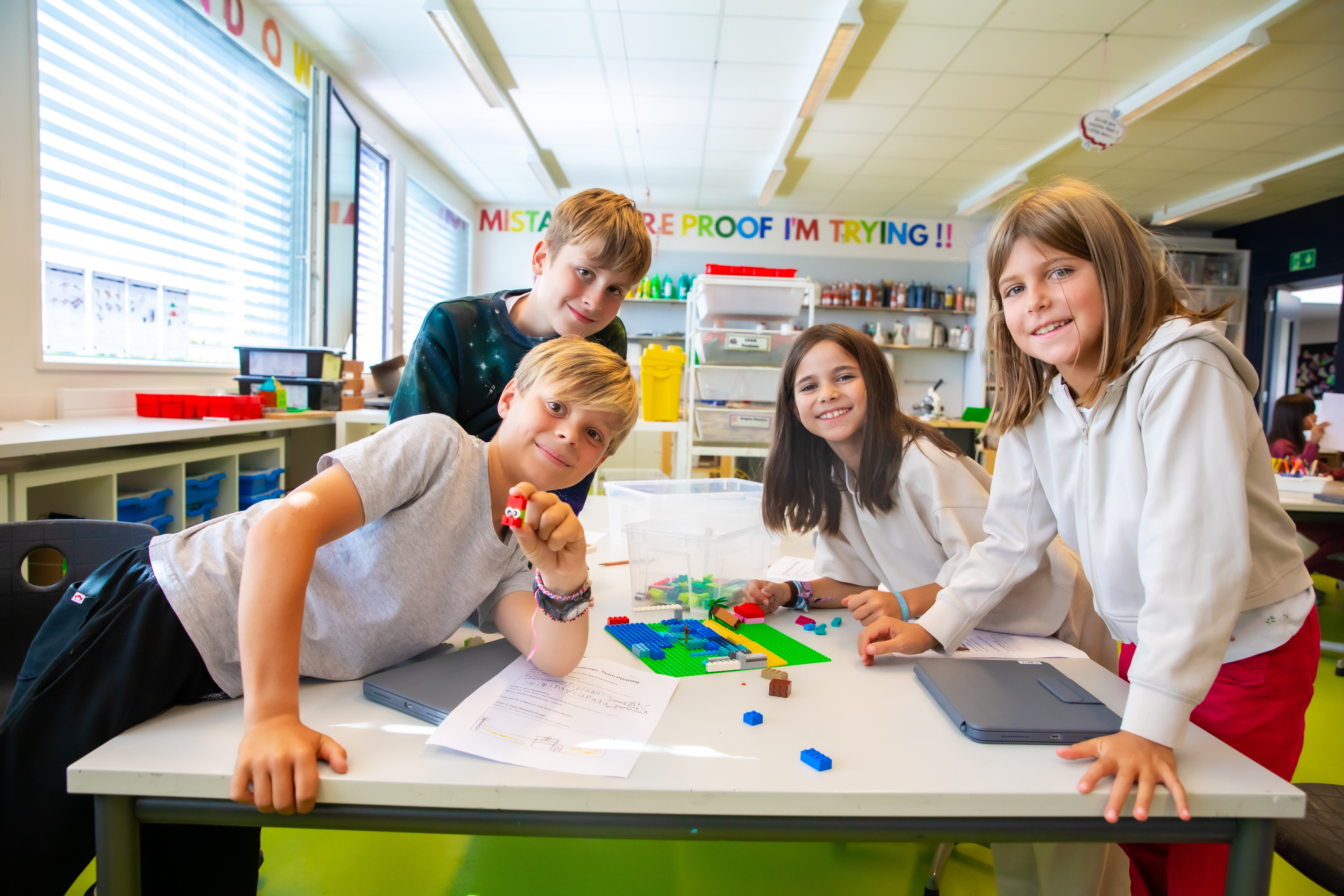
ISL Year 5 learners (and "The World's Cutest Lobster") collaborate in our recent LEGO Design Challenge. (Credit: Kate MacLeod)
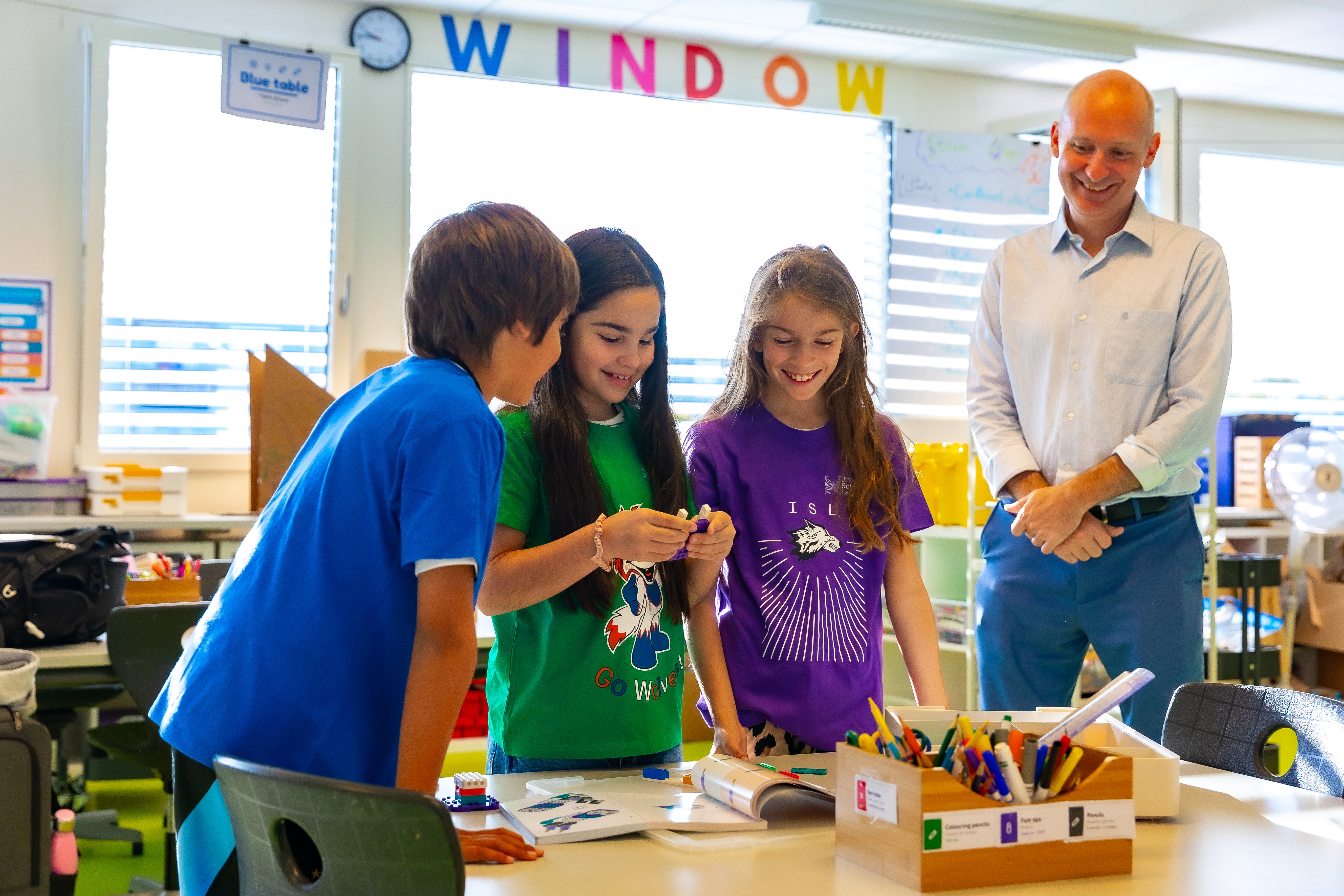
ISL Year 6 learners and Teacher of STEM, Mr Marshall, in our Innovation (STEAM) Laboratory. (Credit: Kate MacLeod)
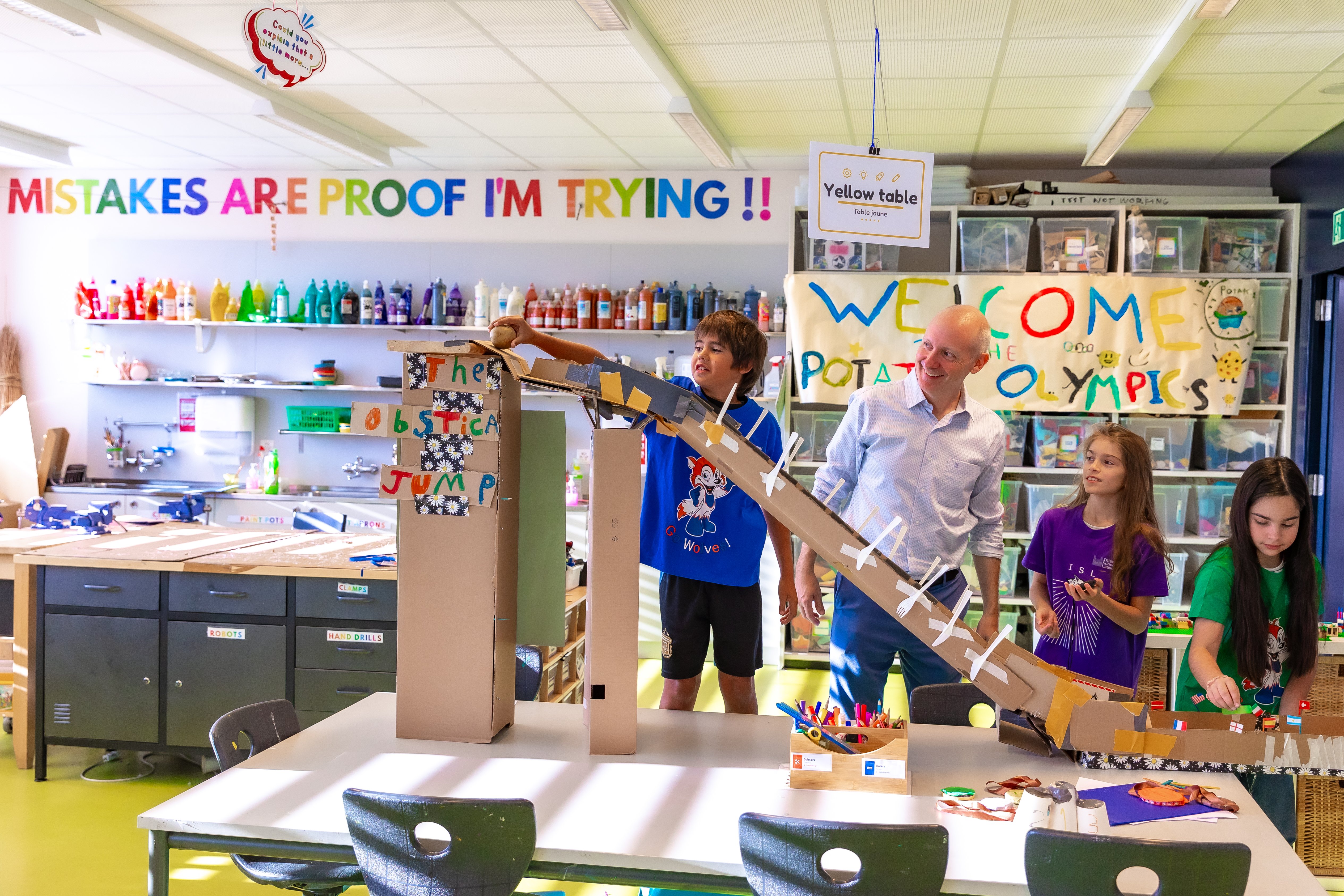
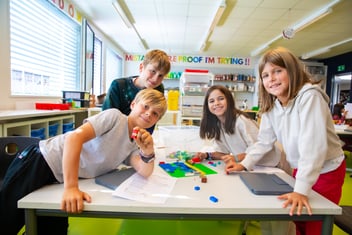
You just need to take one look at these recent photos of the happy faces of our primary students, together with Primary Teacher of STEM, Mr Marshall, collaborating in the Innovation Lab, to see what a lovely place it is to learn: whether (as in these images) working in teams to build Lego structures that symbolise something every member of the group loves, or (as seen in our landing image) engineering ISL’s first ever Ski Jump for the inaugural Potato Olympics (who knew that the root vegetable possessed such valiant athletic skill!), any child with a spark of fascination for the STEM subjects will have it fanned into a flame here; and any child who holds the belief that they “can’t” do Maths or Science, will likely have that conviction emphatically overturned.
It’s unsurprising then, that with not only STEM itself embedded in the curriculum from primary onwards, but, additionally, an ethos that encourages independent learning and scientific exploration, that our IB MYP and DP students are so eager and confident to innovate.
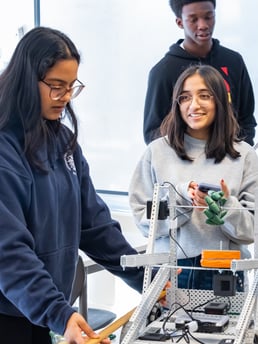 For example, Francesco, who is now studying Economics at Chicago University, was a member of ISL’s “Five Rings” VEX Robotics Co-Curricular Activity in Year 12, a club which Mr Turland was instrumental in establishing, when Saisha (Class of ’24) came to him as a Year 11 in 2021, to pitch him the idea as her International Baccalaureate CAS (Creativity, Activity, and Service) project.
“He was so enthusiastic and supportive from very beginning,” recalls Saisha, now an Electric & Computer Engineering undergraduate at Carnegie Mellon University, who is currently collaborating with robotic and assistive labs to develop RAMMP, a wheelchair-mounted robotic arm that helps users with limited mobility perform everyday tasks independently. Co-Founders Anjali (R) and Saisha (L) in 2023.
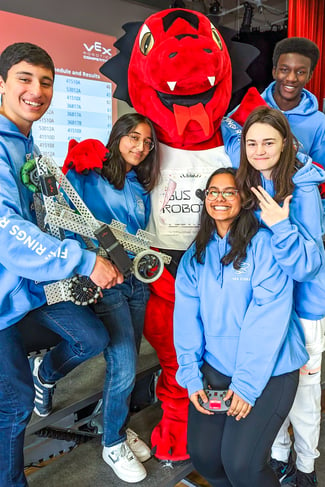 “He helped me and a small group of friends bring the idea to life, and we spent countless afternoons and late evenings in his classroom working on our robot. Mr T was always there to encourage us, help us find competitions, and make sure we had the opportunities and resources to keep pushing ourselves further. Thanks to his dedication and unwavering support, we went from starting a team from scratch to competing at the VEX World Championship in just our second year, which is something I could never have imagined when I first approached him with the idea.
“Looking back, founding VEX was one of my formative high school experiences, sparking my passion for engineering and robotics, which led me to where I am today: I’m involved in assistive robotics research at the Robotics Institute, and have taken on the leadership roles in Carnegie Mellon Racing, our Formula Student engineering team.
L-R: Eladio, Saisha, Anjali, Juliana and Maako. (Credit: Carl Turland)
"Beyond the technical skills, VEX taught me about perseverance, curiosity, leadership, and having the confidence to turn an idea into something real. It also gave me a love for competition, not just for the sake of winning, but for the opportunity to challenge ourselves, learn from the best, and keep improving. Mr Turland played such an important role in fostering that mindset, always encouraging us to aim higher and not be afraid to try something new.
“Seeing how much the VEX Robotics programme has continued to grow at ISL over the years makes me so proud. The drive to challenge yourself, learn from others, and constantly improve is something I’ve found so valuable beyond high school, especially in university and engineering. I’m really glad that, thanks to Mr Turland’s continued dedication* to the programme, future generations of ISL students get to develop that mindset early on through VEX and carry it with them into university and whatever they choose to pursue next. It’s special to see something we started as a small group of friends continue to grow and create those same opportunities for others, and I’m grateful to Mr Turland for continuing to support and inspire students the same way he did for us.”
(For a snapshot of some of the others in the “us” Saisha refers to – the original “Five Rings” members – it’s clear that, like Saisha, their VEX Robotics experience also played a part in the journey to where they are today: “Five Rings” co-founder Anjali is a Computer Science & Economics undergraduate at Brown University, with the additional role of Software Developer at the Center for Technological Responsibility, Reimagination, and Redesign; Maako, is a Stamps President’s Scholar studying Computer Engineering at Georgia Tech, and, as a Machine Learning intern, building learning-based systems for wearables, exoskeletons, and legged robots.)
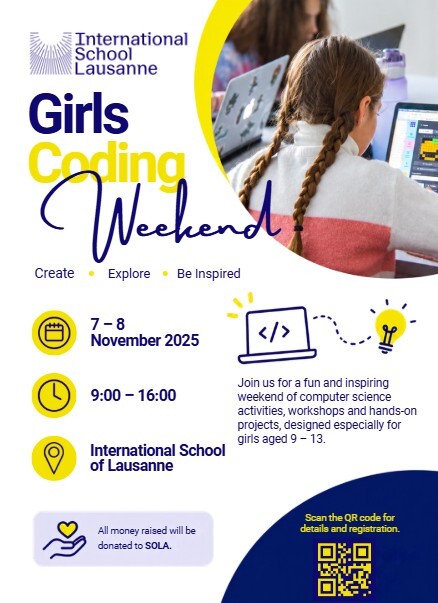
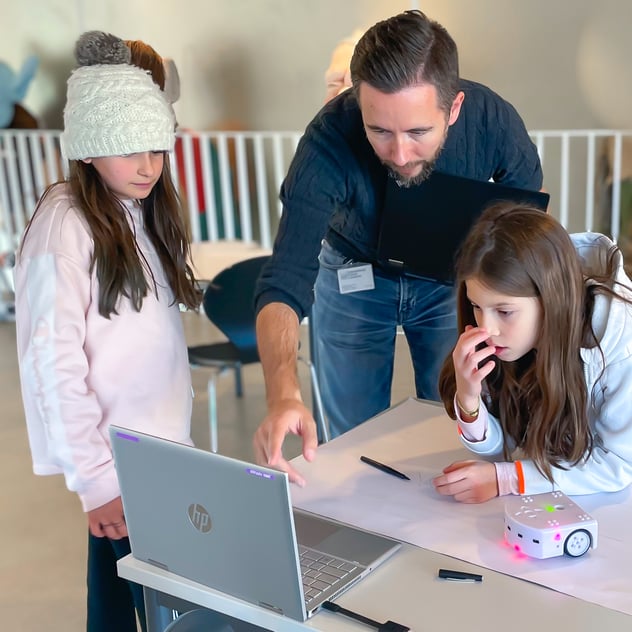 And Mr Turland’s dedication to Co-Curricular opportunities at the International School of Lausanne goes further: this weekend, ISL will host its sixth annual Girls Coding Weekend – a successful and popular part of our calendar which, like the VEX Robotics club, began as a student initiative; in this case, the brainchild of Pavi (ISL Class of 2023) and Divya (ISL Class of 2024), who not only launched this annual event, but also established the Secondary school’s STEM week.
Mr Turland supporting coders at the 2022 Girls Coding Weekend. (Credit: Finn Janeke)
Recalls Divya, who is now an undergraduate at Stanford University, studying Materials Science, and who plays a meaningful holistic role at the university, just as she did at the International School of Lausanne, most recently as Vice President of Impact at the recent Stanford University Climate Week:
 "When I came to Mr Turland in 2021 with a half-formed idea for a Girls Coding weekend, he was immediately on board. Helping us fundraise, pitch the event to staff, and eventually set up laptops and robots during a snowstorm in December, Mr Turland has never been one to say no to a challenge. I don’t remember a day when he wasn’t motivated and smiling! Thank you so much, Mr Turland. You convinced me that no idea is too big to come true."
(Click here to discover more – in Pavi and Divya’s own words – about the story behind the Girls Coding Weekend on the ISL blog.)
And, of course, as Head of Design Technology, Mr Turland is just one of the teachers in a hugely talented, highly experienced, and utterly dedicated team of Design Technology and Computer Science teachers working to ensure that the students of ISL get the most of out of their lessons.
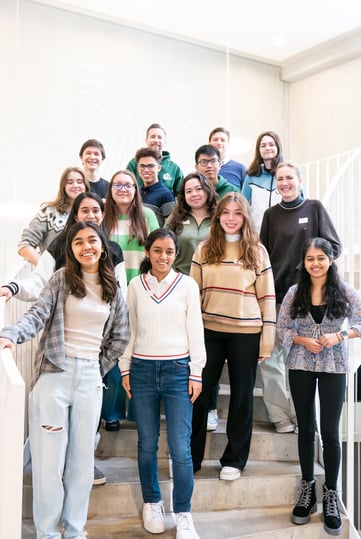
Divya (front left), Pavi (front right), Mr Turland (back left), and the team
of DP students who led the 2022 Girls Coding weekend. (Credit: Finn Janeke)
Popping into one of our state-of-the-art Design Technology classrooms is always a fascinating experience.
Take yesterday: in Mr Tkalec’s Year 7 IB MYP class, which I visited a few weeks back, the students had progressed from building a pen-holder to finalising the shaping of their ergonomic pens, before getting ready for the exciting stage of painting them.
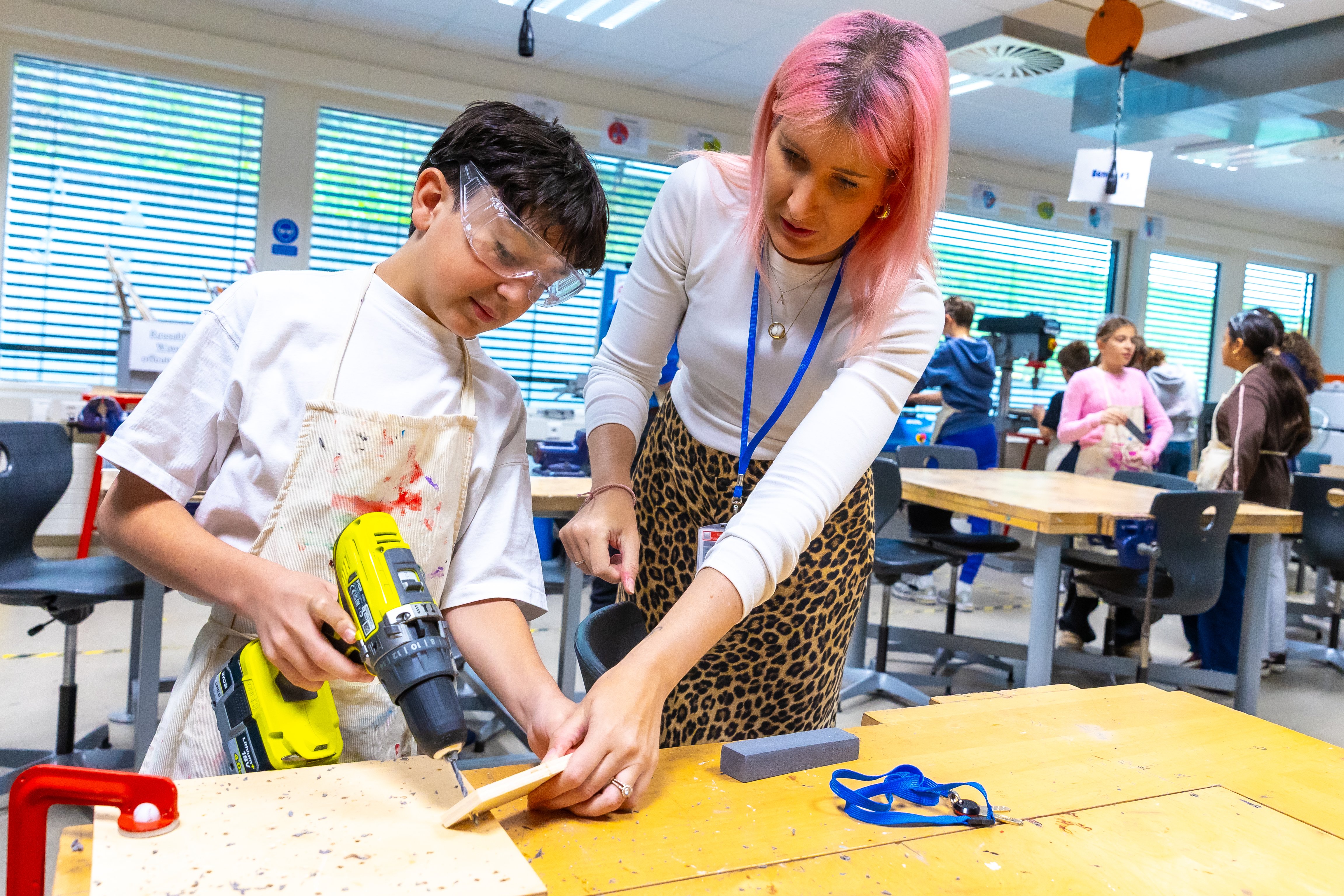
Design Technology Technician, Ms Jaquet, supports a Year 7 learner as he begins building the pen holder for the ergonomic pen he will go on to sculpt from the block on the right of the table. (Credit: Kate MacLeod)
“I’d show you some finished pens from last year, but the students love them so much that they always take them home at the end of the unit,” said Mr Tkalec regretfully, a few minutes before the students thronged exuberantly into the room. Proving Mr Tkalec’s point, when asked if anyone was up for having their photo taken with their work-in-progress, every arm in the room immediately shot up; and, once snapped, the students were eager to share more about their pen concept. (Note: We’ll update this section with photos of the finished pens in a couple of weeks – thanks for inviting us to come back, Mr Tklaec!)
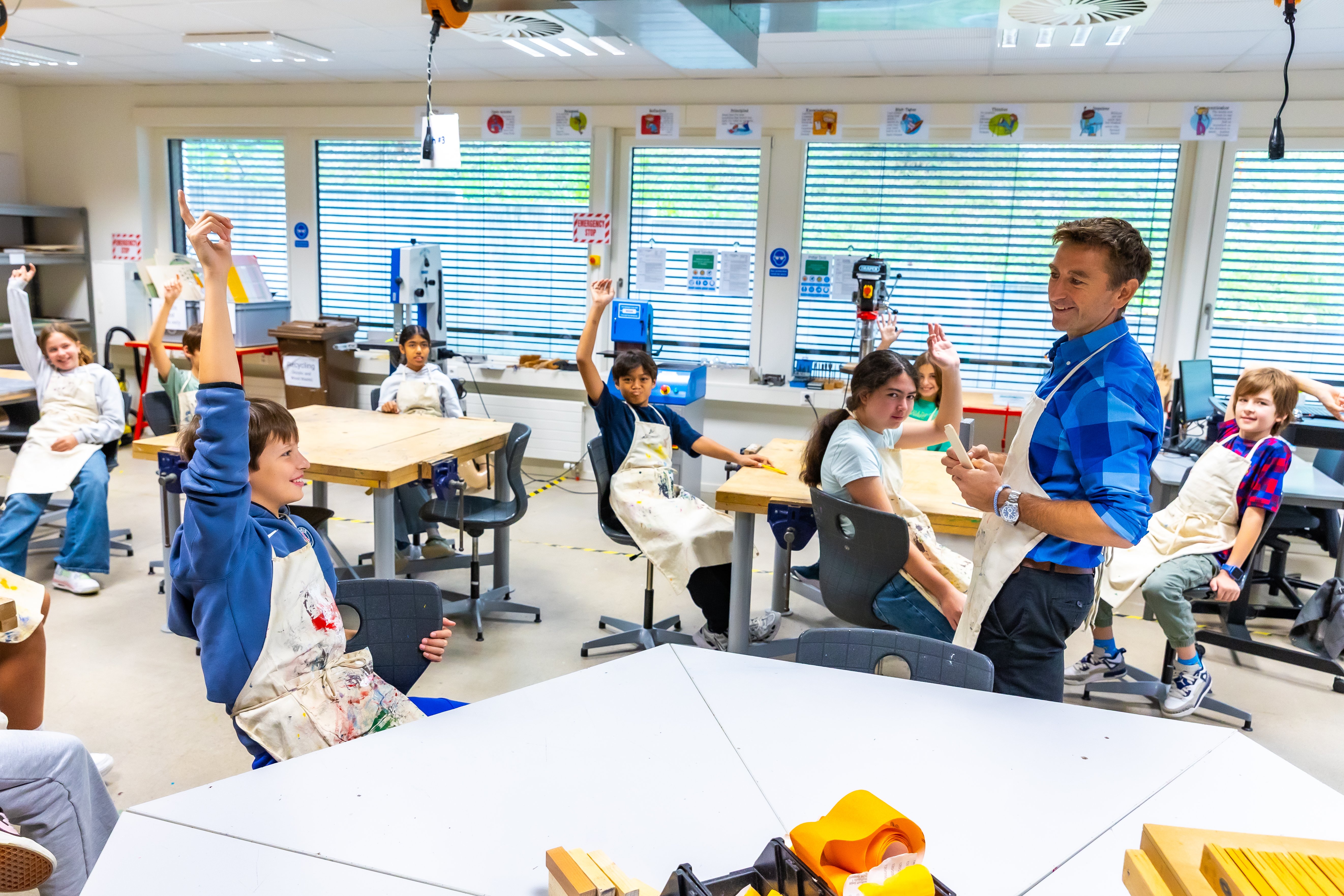
All the enthusiasm! Mr Tkalec's delightfully motivated Year 7 IB MYP Design Technology class. (Credit: Kate MacLeod)
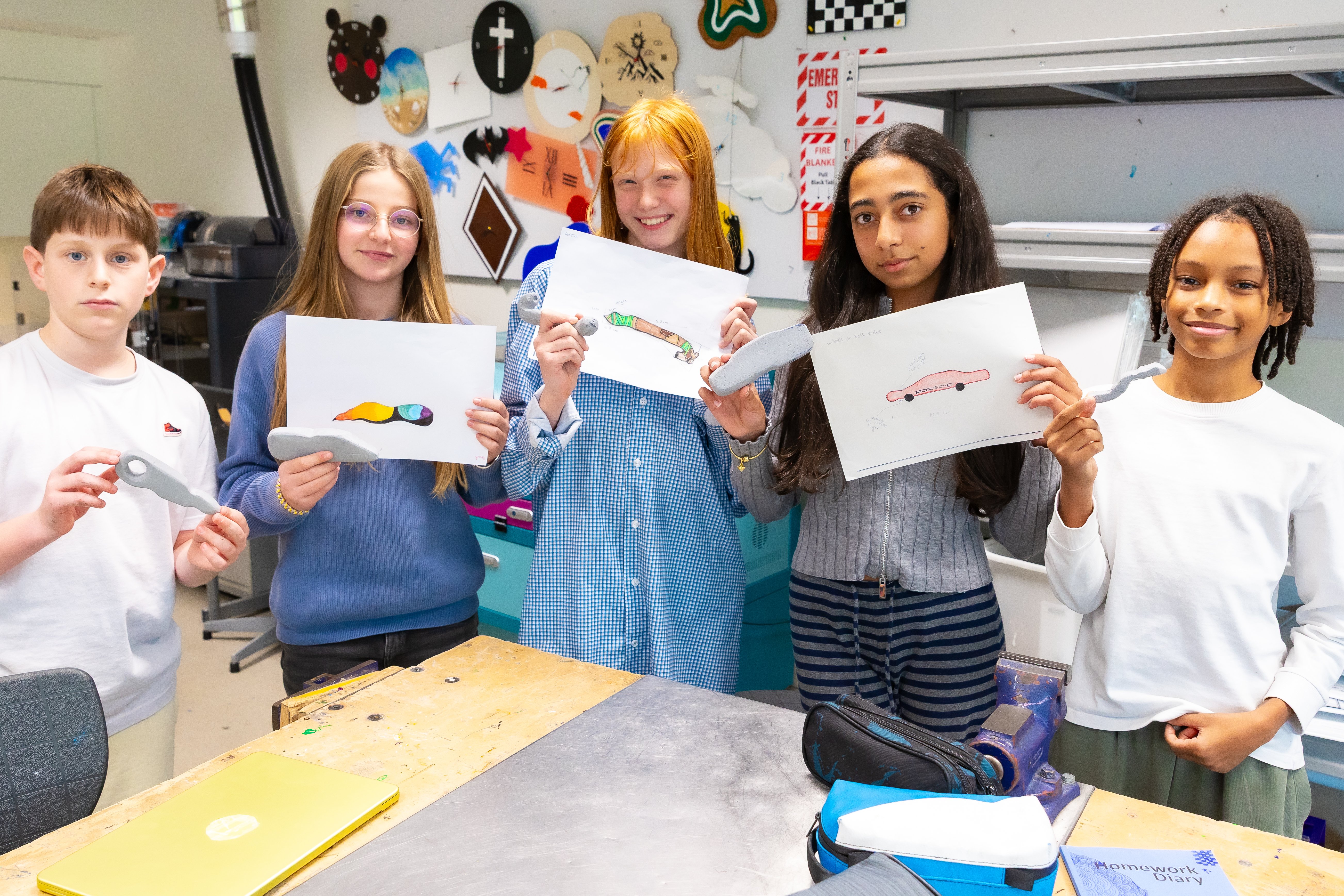
A project in progress: the Year 7s show off their ergonomic pen designs. (Credit: Kate MacLeod)
Meanwhile, next door, in Teacher of Design Mr Carville’s Year 13 class, the IB DP Design Technology students were immersed in the iterative prototyping phase of the Internal Assessment projects – or, to translate the jargon, the stage of the design process in which students build a rough version, test it, find the flaws, and rebuild it better.
There are few better places to be in a school than a classroom where students are absorbed in the flow of creating, and Mr Carville’s DP classroom period 6 and 7 yesterday was no exception. Chilled music played unobtrusively in the background as the students built their prototypes, helped one another out, and spent time in one-on-one feedback and support with Mr Carville, who was on his feet throughout, going from student to student, one moment helping someone out with some 3D printing; the next deep in a discussion about the relationship between function and aesthetics.
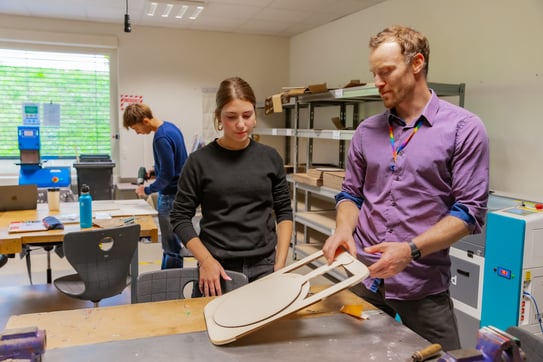
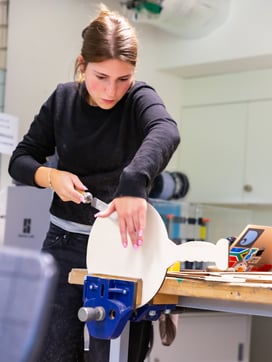
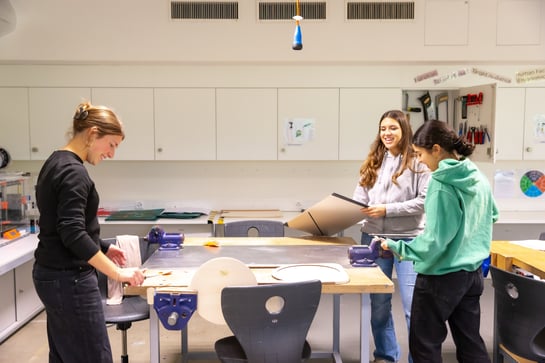
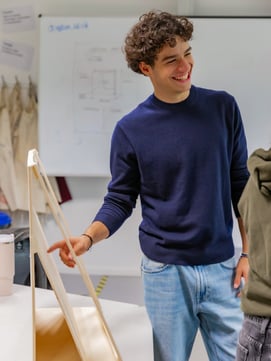
"Absorbed in the flow of creation" - Mr Carville's DP Design Technology class was a pleasure to visit. (Credit: Kate MacLeod)
"For me, this stage of the Internal Assessment is where the culture of the design environment really comes into its own,” enthused Mr Carville afterwards. “Students have spent months developing the habits of constructive thinking, sharing ideas openly, seeking feedback and supporting one another's growth as designers. By the time they reach the prototyping and testing phase, those behaviours become highly visible, creating a real energy in the Design Lab. It's one of my favourite parts of the course because you can see the confidence, trust and design-thinking culture we've built throughout the programme reaching its peak.
"What's particularly interesting is that this stage highlights one of the central paradoxes of Design Technology. Design thinking is inherently collaborative. The best ideas are often shaped through discussion, critique, testing and the exchange of perspectives. Yet the IB Internal Assessment is ultimately an individual piece of work, with each student responsible for developing and evidencing their own solution. A significant part of our role is creating a culture where both can exist side by side. Every student owns and drives their own project, but they do so within a shared creative environment where feedback, encouragement and constructive challenge help refine thinking and push ideas further.
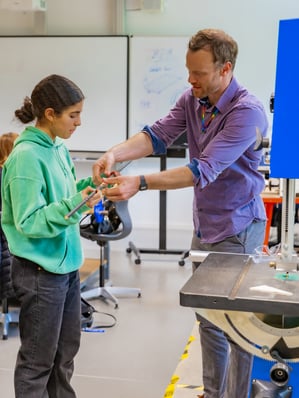 "As a result, while students may be working on entirely different design challenges, the room is full of collaboration. Students are constantly bouncing ideas off one another, challenging assumptions, sharing discoveries and helping each other navigate obstacles in fabrication of concepts. The projects belong to the individual students, but the collective problem-solving and willingness to support one another elevate everyone's work. It's at this point that you really see the strength of the design culture we've built together throughout the course.”
Mr Carville’s passion for his subject is not only evidenced by the enthusiasm and expertise that he brings to his teaching; when he’s not working hard for the students of ISL, he’s busy with his own award-winning sustainable modular start-up, Blocsy.
Mr Carville supporting a student. (Credit: KM)
Partnering with the Circular Economy Switzerland movement, Almighty Tree, and ISL’s very own Impact Hub, Blocsy is a tool-free, circular furniture system designed to combat fast-furniture waste. Compared by one if its users to a “Lego meets Ikea” approach (what’s not to love?!), Blocsy has at its heart several of the United Nations’ Sustainable Development Goals. Any learner in Mr Carville’s classroom is lucky to have as their teacher a true role model for conceptualising and creating sustainable, environmentally friendly design.
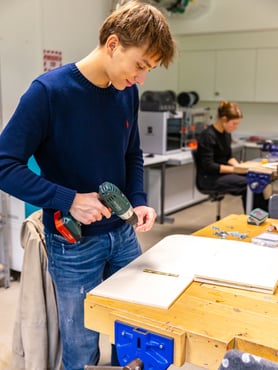 And so, what are this year’s crop of ISL DP Design Technology students creating?
"From reimagining eco-friendly family transport by designing systems that allow standard E-bikes to carry both children and shopping without requiring parents to compromise between a child seat and storage; to redesigning the pizza serving experience through innovative cutting, serving and hosting solutions; or developing smart kitchen tools and cooking stations that make it easier to measure ingredients while following recipes on digital devices, the projects demonstrate the IB Design cycle in practice, as students investigate user needs and develop thoughtful, user-centred solutions to everyday problems based on empathy." (Mr Carville)
DP Des Tech IA: the prototyping stage. (Credit: KM)
What’s so cool (albeit daunting, as someone trying to tell the story) about recounting a narrative about Design Technology, Computer Science, and Robotics at ISL, is that there really is no ending possible, nor any limit to the number of stories to tell.
Even as our, frankly, awe-inspiring alumni build on the foundations they established at the International School of Lausanne to start working towards creating life-changing and life-enhancing contributions within the fields of Robotics, Computer Science and Engineering, and Design Technology, so every year another bright, brilliantly educated group of aspiring Engineers and Designers graduates; and, every year, in the Primary Innovation Lab, sparks of ambition are fanned into flames:
Today, the Potato Olympics; tomorrow, the world…
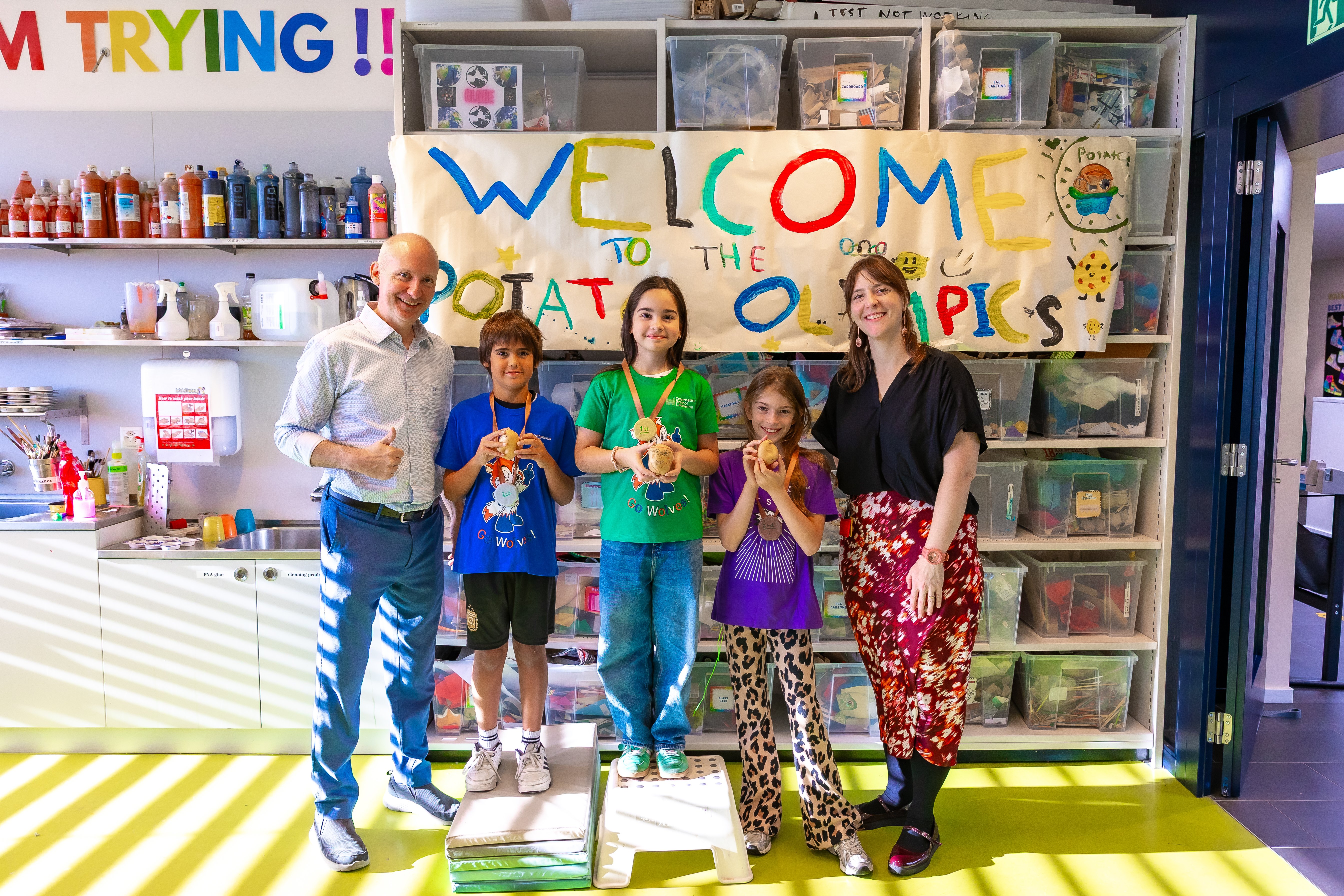
The Potato Olympics: Teacher of STEM, Mr Marshall, Year 6 Future Engineers, and Assistant Principal / PYP Coordinator Ms Schmid. (Credit: Kate MacLeod)
*As of the 2026-2027 school year, Mr Turland has now been joined by the hugely popular Mr Li (Teacher of Digital Design and Computer Science, and leader of Vibe Coding Co-Curricular Activity) to support in the running of both the VEX Robotics Club and Girls Coding Weekend, which Mr Turland has expressed grateful support for: “I don’t know how I managed without him!”
Sign up for the Girls Coding Weekend on 7 and 8 November 2026 using the QR code on the poster below.
Activities and Sport
05 November 2026
Spotlight on Design Technology at the International School of Lausanne: From an Outstanding Educator Award to our First “Potato Olympics”
Read more
Activities and Sport
04 October 2026
Speaking truth to power - Read Mr Friend's powerful opening speech for the new ISL exhibit
Read more
20 August 2026
IMPORTANT: Changes to drop-off and pickup until mid-October
Read more